
What is a Google Penalty?
Did your website traffic suddenly drop? It could be due to Google slapping you with some penalties. Google penalties are actions taken by Google to reduce the visibility and ranking of websites that violate the search engine’s Webmaster Guidelines. These penalties can be manually imposed by a Google quality rater or algorithmically detected. Penalties can have a significant impact on a website’s search engine optimization (SEO) performance, causing a decrease in organic traffic and visibility.
The most common types of penalties are algorithmic penalties (for example, Panda and Penguin updates) and manual penalties. Algorithmic penalties are applied automatically by Google’s algorithms and can be a result of low-quality content, duplicate content, keyword stuffing, and other spammy tactics. Manual penalties (or manual actions) are imposed by Google manual reviewers when they find evidence of spammy or manipulative practices on a website.
To avoid penalties, it’s important to follow best practices for SEO and avoid any unethical tactics. This includes producing high-quality content, building natural inbound links, and ensuring a positive user experience. If a website has received a penalty, the website owner can try to resolve the issue and request a reconsideration through Google Search Console (formerly known as Google Webmaster Tools).
Algorithmic Penalties
Here are a few examples of algorithmic penalties that Google can levy on a website, reducing its performance in competitive searches. At RestoreMySEO.com, our free scanning tool compares that dates you noticed your rankings started dropping with all of the algorithm updates since 2017.
- Panda Update: This algorithm focuses on reducing the ranking of low-quality or thin content websites, such as content farms, and promotes websites with high-quality content.
- Penguin Update: This algorithm targets websites using manipulative link building tactics, such as buying links or participating in link schemes, and can result in a decrease in visibility and ranking.
- E-A-T Update: This update emphasizes the importance of expertise, authoritativeness, and trustworthiness (E-A-T) in the content of a website and can affect the ranking of websites that don’t meet these criteria, especially in the health and financial sectors.
- Mobile-First Update: This algorithm prioritizes mobile-friendly websites over those that are not optimized for mobile devices and can negatively impact the ranking of websites that do not provide a good mobile user experience.
- Core Updates: Google regularly releases broad, unconfirmed updates that can result in fluctuations in ranking and visibility for websites. These updates can be caused by changes in Google’s ranking algorithms and can have a significant impact on websites that violate best practices for SEO.
- HTTPS/SSL Update: This update prioritizes websites that have a secure socket layer (SSL) certificate and a secure HTTPS connection, and can negatively impact the ranking of websites that do not have these security measures in place.
- BERT Update: This update focuses on understanding natural language queries and the context in which they are used, and can affect the ranking of websites that don’t provide clear, relevant, and helpful content.
- Local Search Algorithm: This algorithm helps to provide accurate and relevant local search results and can penalize websites that have inconsistent or inaccurate information about their business location, such as incorrect addresses or phone numbers.
- Structured Data Algorithm: This algorithm rewards websites that use structured data, such as schema markup, to provide additional information to search engines and can penalize websites that do not use structured data or use it improperly.
- Speed Update: This update prioritizes websites that load quickly and can negatively impact the ranking of websites that have slow load times or are not optimized for speed.
Manual Actions
Manual actions are penalties imposed by Google quality raters on websites that violate Google’s Webmaster Guidelines. Here are some examples of manual actions:
- Spammy Structured Markup: If a website uses structured markup in a way that is misleading or manipulative, Google may issue a manual action.
- Unnatural or Low Quality Links: If a website engages in link schemes, such as buying links or participating in link exchanges, Google may issue a manual action.
- Malware: If a website is hacked and malicious content is added, Google may issue a manual action.
- User-Generated Spam: If user-generated content, such as comments or forums, on a website is spammy or low-quality, Google may issue a manual action.
To resolve a manual action, the website owner must first identify the cause of the problem and take steps to correct it. Next, the website owner can request a reconsideration of the manual action through Google Search Console. The request should include a detailed explanation of the steps taken to resolve the issue and prevent it from happening again in the future. Google will review the request and, if the manual action has been resolved, will lift the penalty and restore the website’s visibility and ranking in search results.
How To Find If You’ve Been Penalized in Google Search Console
To check if your website has received a manual or algorithmic penalty in Google, you can go to the “Manual Actions” section in Google Search Console. Here’s how:
- Go to Google Search Console (https://search.google.com/search-console).
- Sign in to your account and select your website.
- Go to the “Security & Manual Actions” section.
- Look for a message indicating whether your website has received a manual action. If there is no message, your website has not received a manual penalty.
- If you have received a manual penalty, you will see a message indicating the type of penalty and the specific pages or content that are affected.
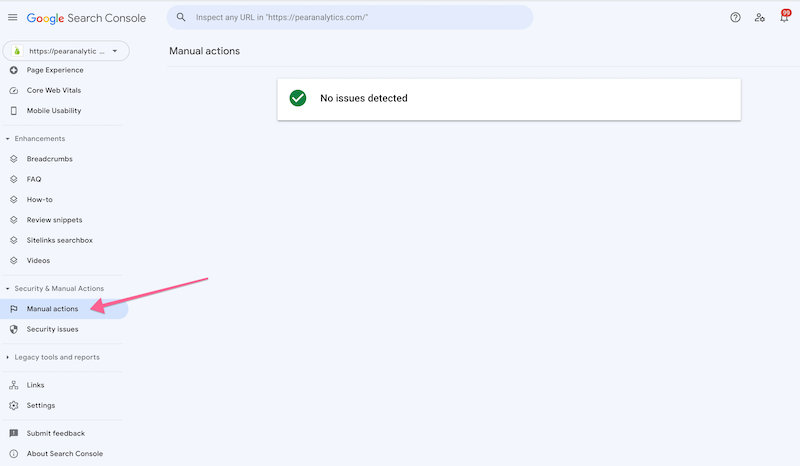
It’s important to regularly check the “Manual Actions” section in Google Search Console to monitor your website’s status and ensure that it remains in compliance with Google’s guidelines. By staying informed about any penalties, you can take steps to resolve the issue and restore your website’s visibility and ranking in search results.
More Examples To Avoid
Doorway Pages: Doorway pages are web pages that are designed to rank well in search engines for specific keywords or phrases, but then redirect the user to a different page or website. These pages are often created with the sole purpose of manipulating search engine rankings and are not designed to provide a good user experience.
Sneaky Mobile Redirects: Sneaky mobile redirects refer to when a website automatically redirects users who access the site on a mobile device to a different page or website, without their consent. This can be done to show different content, ads, or promotions to mobile users, but can also result in a poor user experience, as the user may be redirected to a page they did not intend to visit.
Spammy Backlinks: Spammy links are links from low-quality or irrelevant websites that are placed with the intention of artificially boosting a website’s ranking in search results. These spam links can come from sources such as link farms, paid link networks, or automated link building tools, and are not based on genuine relationships or the relevance of the content.
Pro Tip: RestoreMySEO will run a full analysis on your domain and find all of the Toxic links pointing to your website and remove them.
Comment Spam: Comment spam can potentially lead to a Google penalty on your website. Comment spam refers to adding irrelevant or low-quality comments to a website in order to manipulate search engine rankings or drive traffic to another site.
To avoid comment spam, it’s important to monitor and moderate comments on your website and remove any comments that are spammy or violate your comment policy. You can also implement measures to prevent comment spam, such as using CAPTCHAs, moderating comments before they are published, or limiting the number of links that can be included in a comment. By preventing comment spam, you can ensure that your website remains in compliance with Google’s guidelines and maintains its visibility and ranking in search results.
Thin Content: A thin content penalty from Google refers to a penalty that is imposed on a website that has low-quality or insufficient content. Thin content is often defined as content that provides little or no value to the user, is duplicated from other sources, or is otherwise considered to be of poor quality.
Google’s algorithm is designed to provide users with the most relevant and high-quality search results. As a result, websites that are deemed to have thin content are often penalized by Google, resulting in a decrease in visibility and ranking in search results.
A thin content penalty can have a significant impact on a website’s traffic and revenue, as it may result in a decrease in organic search traffic and a lower position in search results for relevant keywords.
To avoid a thin content penalty from Google, it’s important to focus on producing high-quality and relevant content that provides value to users. This may involve creating original and informative blog posts, product descriptions, and other types of content that are unique and not duplicated from other sources. By providing valuable content, you can help to establish your website as an authoritative source in your industry and improve your visibility and ranking in search results.

It’s important to avoid these “black hat” SEO techniques, as they violate Google’s Webmaster Guidelines and can result in manual penalties or algorithmic penalties. Additionally, these techniques often provide low-quality or irrelevant content and can lead to a negative user experience, which can result in a high bounce rate and decreased engagement.
They also negatively impact the overall visibility and ranking of a website and its related pages, as well as potentially harm the reputation of a website and its brand. It’s better to focus on creating high-quality, relevant, and original content that provides value to users and naturally attracts links and traffic from search engines.
What To Do if You Have A Manual Penalty
If you find that your website has received a manual penalty from Google, you need to take the following steps to resolve the issue and have the penalty lifted:
- Identify the cause of the penalty: Review Google’s Webmaster Guidelines to determine what may have caused the penalty. You can also use Google Search Console to find out which pages are affected and what specific issues are causing the penalty.
- Correct the issue: Make the necessary changes to your website to correct the issue causing the penalty. This may involve removing low-quality or spammy content, removing links that violate Google’s guidelines, or fixing technical issues such as security breaches.
- Document your changes: Keep a record of the changes you made and the steps you took to correct the issue. This information will be needed when you submit your reconsideration request.
- Submit a reconsideration request: Use Google Search Console to submit a reconsideration request, explaining the changes you made and why the penalty should be lifted. Be as detailed and specific as possible in your request.
- Wait for a response: Google will review your request and, if the manual penalty has been resolved, will lift the penalty and restore the website’s visibility and ranking in search results. If the penalty remains in place, Google will provide additional information on what needs to be corrected.
It’s important to keep in mind that resolving a manual penalty can take time, and that the process requires patience and attention to detail. Make sure that you fully understand and comply with Google’s Webmaster Guidelines to avoid similar penalties in the future.
What Does a Good Backlink Profile Look Like?
A good backlink profile is an essential component of effective SEO. Here are some characteristics of a good backlink profile:
- Relevance: The links should be relevant to the content on your website and to the topics you cover.
- Diversity: The links should come from a variety of sources, including high-authority websites, social media platforms, and industry-specific websites.
- Quality: The links should be from reputable and high-authority websites with a strong history of content creation and engagement.
- Natural Growth: The backlink profile should grow naturally over time and not involve any artificial or manipulative link building tactics.
- Anchor Text Diversity: The anchor text used in the links should be diverse and not consist primarily of the same keyword-rich phrases.
- Geographic diversity: The links should come from a range of geographic locations, rather than being concentrated in a single area.
- Contextual links: The links should be placed within relevant and meaningful context on the linking website, rather than being placed in irrelevant or low-quality sections of the website.
- Link velocity: The rate at which links are acquired should be consistent and not involve sudden spikes or drops.
By focusing on these key characteristics, you can build a strong and effective backlink profile that will help to improve your website’s visibility and ranking in search results.
